Introduction
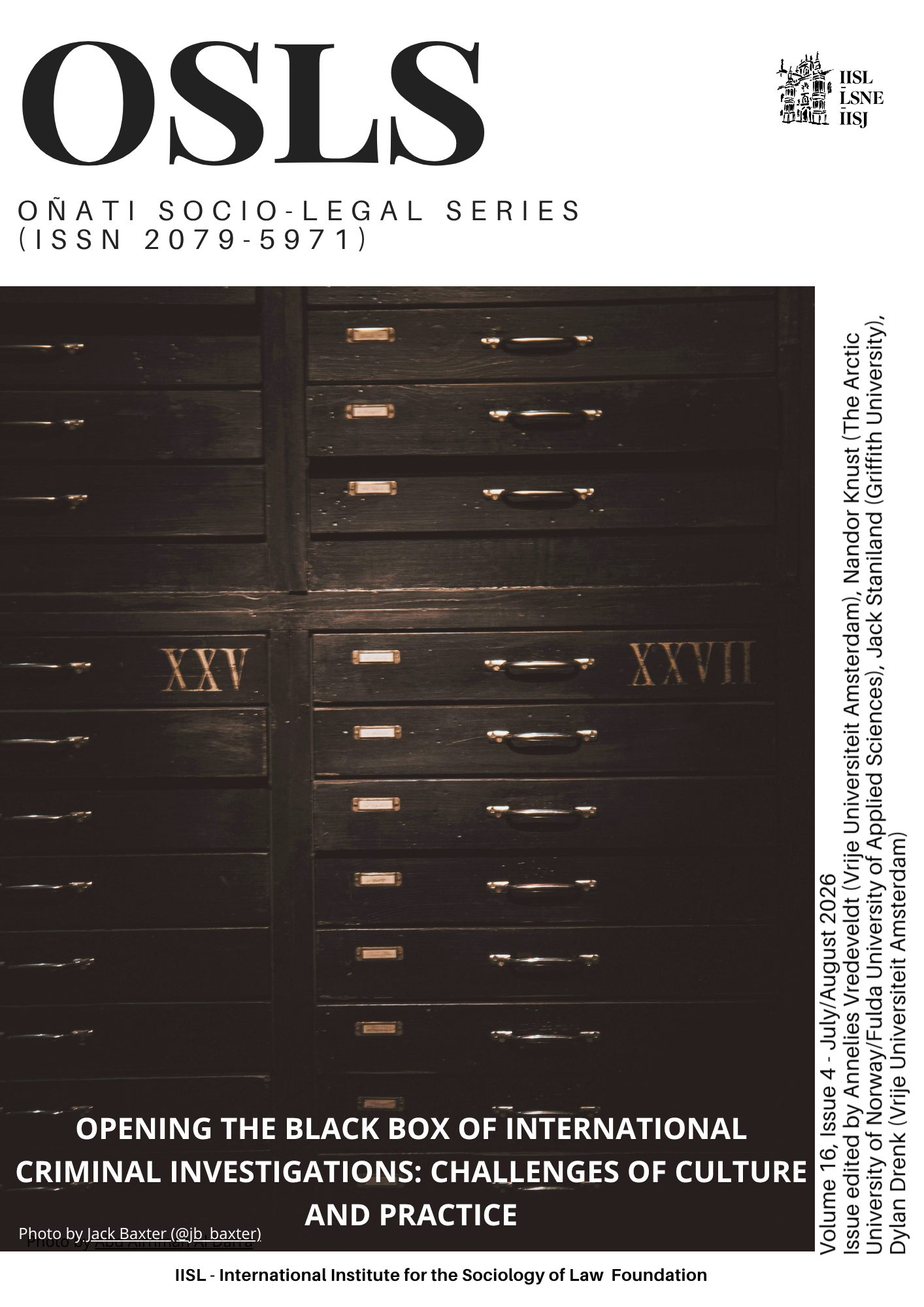
Opening the black box of international criminal investigations: Challenges of culture and practice
DOI:
https://doi.org/10.35295/osls.iisl.2785Parole chiave:
International criminal investigations, eyewitness testimony, cross-cultural communication, cultural humility, open source intelligenceAbstract
This Special Issue examines the everyday practice of international criminal investigations, focusing on how culture, communication, and technology shape what comes to count as truth. Drawing on interdisciplinary contributions, it shows that investigative work in post-conflict settings depends on the history of the conflict, the evidence that is available, institutional constraints, and how investigators and witnesses interpret and communicate events. The articles highlight the importance of cultural humility, careful communication from first contact to courtroom, and critical reflection on emerging technologies. Together, they demonstrate that improving international investigations requires context-sensitive practices that explicitly acknowledge uncertainty and reduce bias.
Downloads
Metrics
Statistiche globali ℹ️
|
42
Visualizzazioni
|
21
Download
|
|
63
Totale
|
|
Riferimenti bibliografici
Aksamitowska, K., 2021. Digital evidence in domestic core international crimes prosecutions: Lessons learned from Germany, Sweden, Finland and The Netherlands. Journal of International Criminal Justice [online], 19(1), 189-211. Available at: https://doi.org/10.1093/jicj/mqab035 DOI: https://doi.org/10.1093/jicj/mqab035
Bouwknegt, T. B., 2026. The past is a foreign country: On investigative cultures that investigate mass violence across cultures. Oñati Socio-Legal Series [online], 16(4-this issue). Available at: https://doi.org/10.35295/osls.iisl.2386 DOI: https://doi.org/10.35295/osls.iisl.2386
Brouillard, C., Gabbert, F., and Scott, A. J., 2024. Addressing current issues in assessing professional rapport: A systematic review and synthesis of existing measures. Applied Cognitive Psychology [online], 38(3), e4205. Available at: https://doi.org/10.1002/acp.4205 DOI: https://doi.org/10.1002/acp.4205
Combs, N. A., 2010. Fact-finding without facts: The uncertain evidentiary foundations of international criminal convictions. Cambridge University Press. DOI: https://doi.org/10.1017/CBO9780511760259
Combs, N. A., 2017. Grave crimes and weak evidence: A fact-finding evolution in international criminal law. Harvard International Law Journal, 58(1), 47–125.
Combs, N. A., 2026. Cultural competence amidst evidentiary transformations: Why culture still matters. Oñati Socio-Legal Series [online], 16(4-this issue). Available at: https://doi.org/10.35295/osls.iisl.2504 DOI: https://doi.org/10.35295/osls.iisl.2504
De Bruïne, G., Vredeveldt, A., and Van Koppen, P. J., 2025. The way we remember and report: An experiment testing cultural differences in eyewitness memory. Memory [online], 33(6), 644–653. Available at: https://doi.org/10.1080/09658211.2025.2505213 DOI: https://doi.org/10.1080/09658211.2025.2505213
Drenk, D., et al., 2026a. Cross-cultural communication in the courtroom: A case study of the International Criminal Tribunal for Rwanda. Journal of Criminal Psychology [online], 16(2), 243–255. Available at: https://doi.org/10.1108/JCP-12-2024-0135 DOI: https://doi.org/10.1108/JCP-12-2024-0135
Drenk, D., et al., 2026b. Myriad meanings: Coded language and euphemisms at the International Criminal Tribunal for Rwanda. Oñati Socio-Legal Series [online], 16(4-this issue). Available at: https://doi.org/10.35295/osls.iisl.2420 DOI: https://doi.org/10.35295/osls.iisl.2420
Hope, L., De la Fuente Vilar, A., et al., 2026. Communication errors in online interactions: Examining cultural differences in perceptions of rapport and preferred recovery strategies. Oñati Socio-Legal Series [online], 16(4-this issue). Available at: https://doi.org/10.35295/osls.iisl.2354 DOI: https://doi.org/10.35295/osls.iisl.2354
Hope, L., Hawkins de Namor, N., et al., 2026. From an investigator’s perspective: Challenges and opportunities in building and maintaining rapport in cross-cultural investigative interviewing contexts. Journal of Criminal Psychology [online], 16(2), 201–226. Available at: https://doi.org/10.1108/JCP-11-2024-0123 DOI: https://doi.org/10.1108/JCP-11-2024-0123
Kizilhan, J. I., 2025. Interviews with survivors of catastrophic events: Possibilities, risks, and culturally sensitive perspectives. Psychiatry and Psychological Disorders [online], 4(3), 1–9. Available at: https://doi.org/10.58489/2836-3558/037 DOI: https://doi.org/10.58489/2836-3558/037
McDermott, Y., Hausknecht, A., and Liefgreen, A., 2026. New evidence, new challenges: ICC judges’ perspectives on user-generated evidence and judging in an age of artificial intelligence. Oñati Socio-Legal Series [online], 16(4-this issue). Available at: https://doi.org/10.35295/osls.iisl.2375 DOI: https://doi.org/10.35295/osls.iisl.2375
Michels, A., et al., 2024. Integration of mental health and psychosocial support approaches in accountability mechanisms for atrocity crimes [online]. Knowledge Platform for Security and Rule of Law. Available at: https://kpsrl.org/publication/integration-of-mental-health-and-psychosocial-support-approaches-in-accountability-mechanisms-for-atrocity-crimes
Nistor, A. L., 2026. ICC courtroom encounters: Negotiating justice, adjudicating culture. Doctoral dissertation, University of Groningen.
Oostinga, M. S. D., Giebels, E., and Taylor, P. J., 2017. ‘An error is feedback’: The experience of communication error management in crisis negotiations. Police Practice and Research [online], 1–14. Available at: https://doi.org/10.1080/15614263.2017.1326007 DOI: https://doi.org/10.1080/15614263.2017.1326007
Schot, S., 2026. Identifying and locating potential witnesses of international crimes through third parties ‘On the Ground’: A trauma-informed process? Oñati Socio-Legal Series [online], 16(4-this issue). Available at: https://doi.org/10.35295/osls.iisl.2352 DOI: https://doi.org/10.35295/osls.iisl.2352
Staniland, J., et al., 2025. ‘How do we investigate two million murders?’ A systematic review of practices and problems in international criminal justice. Psychology, Crime & Law [online], Advance online publication, 1–29. Available at: https://doi.org/10.1080/1068316X.2025.2572315 DOI: https://doi.org/10.1080/1068316X.2025.2572315
Stewart, J. K., 2026. Drawing on the experience of prosecuting at the international level in multicultural environments. Oñati Socio-Legal Series [online], 16(4-this issue). Available at: https://doi.org/10.35295/osls.iisl.2787 DOI: https://doi.org/10.35295/osls.iisl.2787
Tervalon, M., and Murray-García, J., 1998. Cultural humility versus cultural competence: A critical distinction in defining physician training outcomes in multicultural education. Journal of Health Care for the Poor and Underserved [online], 9(2), 117–125. Available at: https://doi.org/10.1353/hpu.2010.0233 DOI: https://doi.org/10.1353/hpu.2010.0233
Vredeveldt, A., and Ferra, F., 2026. Adopting a cultural humility approach in international criminal investigations. Oñati Socio-Legal Series [online], 16(4-this issue). Available at: https://doi.org/10.35295/osls.iisl.2344 DOI: https://doi.org/10.35295/osls.iisl.2344
Vredeveldt, A., Given-Wilson, Z., and Memon, A., 2026. Culture, trauma, and memory in investigative interviews. Psychology, Crime & Law [online], 32(1), 300–320. Available at: https://doi.org/10.1080/1068316X.2023.2209262 DOI: https://doi.org/10.1080/1068316X.2023.2209262
##submission.downloads##
Pubblicato
Come citare
Fascicolo
Sezione
Licenza
Copyright (c) 2026 Annelies Vredeveldt, Nandor Knust, Jack Staniland, Dylan Drenk

Questo lavoro è fornito con la licenza Creative Commons Attribuzione - Non commerciale - Non opere derivate 4.0 Internazionale.
OSLS strictly respects intellectual property rights and it is our policy that the author retains copyright, and articles are made available under a Creative Commons licence. The Creative Commons Non-Commercial Attribution No-Derivatives licence is our default licence and it regulates how others can use your work. Further details available at https://creativecommons.org/licenses/by-nc-nd/4.0 If this is not acceptable to you, please contact us.
The non-exclusive permission you grant to us includes the rights to disseminate the bibliographic details of the article, including the abstract supplied by you, and to authorise others, including bibliographic databases, indexing and contents alerting services, to copy and communicate these details.
For information on how to share and store your own article at each stage of production from submission to final publication, please read our Self-Archiving and Sharing policy.
The Copyright Notice showing the author and co-authors, and the Creative Commons license will be displayed on the article, and you must agree to this as part of the submission process. Please ensure that all co-authors are properly attributed and that they understand and accept these terms.