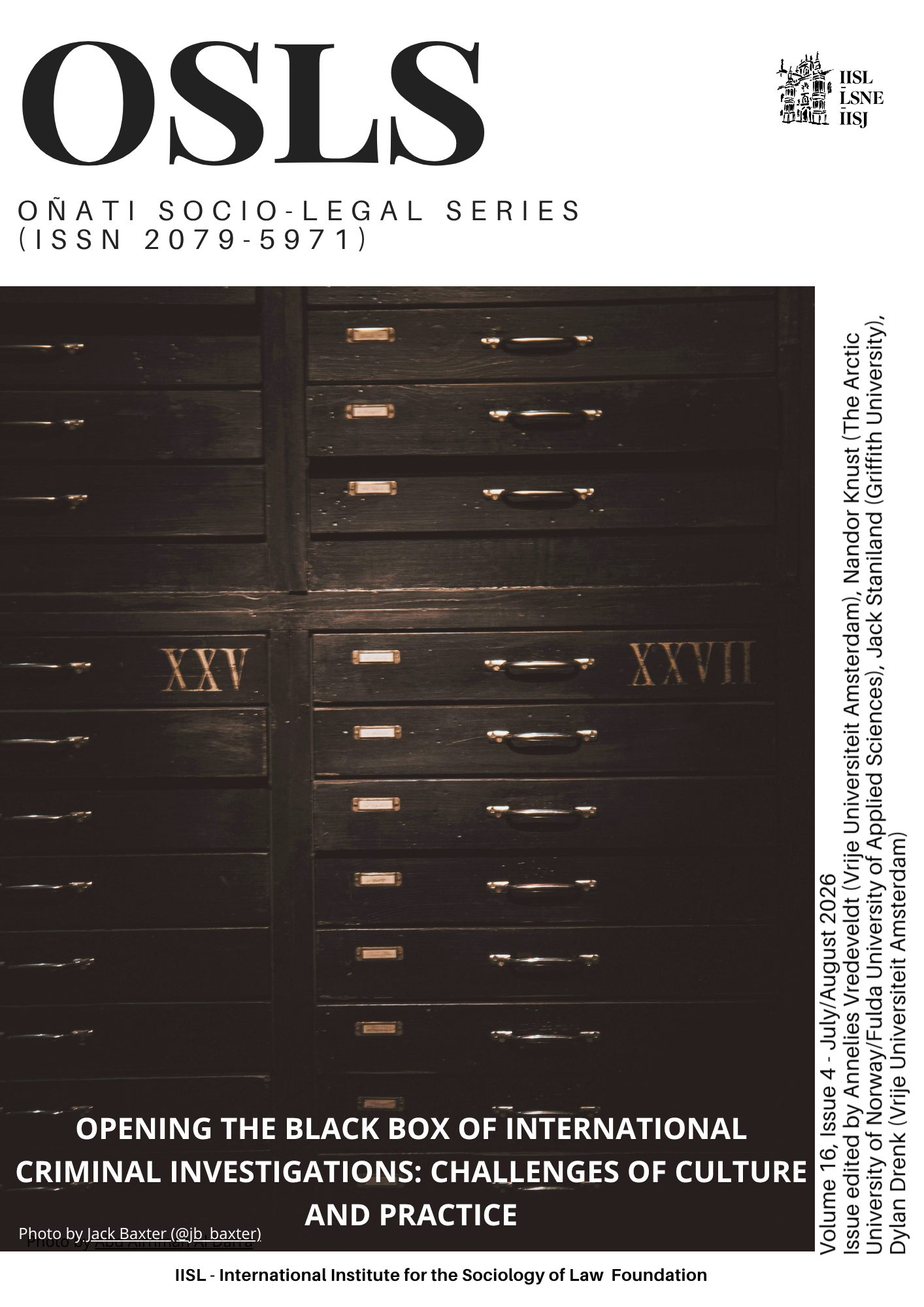
Adopting a cultural humility approach in international criminal investigations
DOI:
https://doi.org/10.35295/osls.iisl.2344Keywords:
cultural humility, investigative interviewing, cross-cultural communication, police trainingAbstract
The most important form of evidence in international criminal investigations is information from people. This is often obtained by interviewing people from different cultural backgrounds. Recent articles drawing attention to the role of culture in investigative interviews have recommended culture-specific guidelines. Here, we argue that rather than detailed guidelines, we need a change in mindset. One promising approach is that of ‘cultural humility’, a concept borrowed from the medical field. Based on the scientific literature and Oñati expert panels, we developed an investigative interviewer training inspired by cultural humility. We tested its effectiveness with 28 experienced investigative interviewers from different professional fields. Here, we reflect on the practitioners’ experiences and feedback on the training and propose a new way forward to improve cross-cultural investigative interviewing. Adopting a new mindset should not only promote the well-being of interviewees, but also facilitate the collection of valuable information in international criminal investigations.
Downloads
Metrics
Global Statistics ℹ️
|
651
Views
|
548
Downloads
|
|
1199
Total
|
|
References
Akechi, H., et al., 2013. Attention to eye contact in the West and East: Autonomic responses and evaluative ratings. PLoS ONE [online], 8(3), e59312. Available at: https://doi.org/10.1371/journal.pone.0059312
Amato, A., and Gallai, F., 2024. The multiple roles of interpreters in asylum hearings in Italy. MediAzioni [online], 41, D8-D39. Available at: https://doi.org/10.6092/issn.1974-4382/19754
Anakwah, N., 2022. Cross-cultural investigative interviews. In: S. Landström, P.A. Granhag, and P.J. van Koppen, eds., The future of forensic psychology [online]. London: Routledge, 47–57. Available at: https://doi.org/10.4324/9781003308546
Apicella, C., Norenzayan, A., and Henrich, J., 2020. Beyond WEIRD: A review of the last decade and a look ahead to the global laboratory of the future. Evolution and Human Behavior [online], 41(5), 319–329. Available at: https://doi.org/10.1016/j.evolhumbehav.2020.07.015
Beune, K., Giebels, E., and Taylor, P.T., 2010. Patterns of interaction in police interviews: The role of cultural dependency. Criminal Justice and Behavior [online], 37(8), 904–925. Available at: https://doi.org/10.1177/0093854810369623
Bouwknegt, T. B., 2026. The past is a foreign country: On investigative cultures that investigate mass violence across cultures. Oñati Socio-Legal Series [online], 16(4-this issue). Available at: https://doi.org/10.35295/osls.iisl.2386
Brøndum, T., 2023. “The curse of the refugee”: Narratives of slow violence, marginalization and non-belonging in the Danish welfare state. Kvinder, Køn and Forskning [online], 36(2), 96-112. Available at: https://doi.org/10.7146/kkf.v36i2.141131
Brouillard, C., Gabbert, F., and Scott, A.J., 2024. Addressing current issues in assessing professional rapport: A systematic review and synthesis of existing measures. Applied Cognitive Psychology [online], 38(3), e4205. Available at: https://doi.org/10.1002/acp.4205
Chavez, V., 2012. Cultural humility: People, principles and practices. YouTube [online]. Available at: https://www.youtube.com/watch?v=SaSHLbS1V4w
Comas-Díaz, L., Hall, G.N., and Neville, H.A., 2019. Racial trauma: Theory, research, and healing: Introduction to the special issue. American Psychologist [online], 74(1), 1-5. Available at: https://doi.org/10.1037/amp0000442
Combs, N. A., 2026. Cultural competence amidst evidentiary transformations: Why culture still matters. Oñati Socio-Legal Series [online], 16(4-this issue). Available at: https://doi.org/10.35295/osls.iisl.2504
Combs, N.A., 2010. Fact-finding without facts: The uncertain evidentiary foundations of international criminal convictions. Cambridge University Press.
Cordis, 2019. Beyond WEIRD witnesses: Eyewitness memory in cross-cultural contexts [online]. Available at: https://cordis.europa.eu/project/id/802080
Crenshaw, K., 1989. Demarginalizing the intersection of race and sex: A black feminist critique of antidiscrimination doctrine, feminist theory and antiracist politics. University of Chicago Legal Forum [online], 1, 139–167. Available at: http://chicagounbound.uchicago.edu/uclf/vol1989/iss1/8
De Bruïne, G., Vredeveldt, A., and van Koppen, P.J., 2023. Culture and credibility: The assessment of asylum seekers’ statements. Psychology, Crime and Law [online], 1–23. Available at: https://doi.org/10.1080/1068316X.2023.2279328
De Bruïne, G., Vredeveldt, A., and van Koppen, P.J., 2025. The way we remember and report: An experiment testing cultural differences in eyewitness memory. Memory [online], 33(6). Available at: https://doi.org/10.1080/09658211.2025.2505213
Denault, V., and Talwar, V., 2023. From criminal interrogations to investigative interviews: A bibliometric study. Frontiers in Psychology [online], 14, 1-16. Available at: https://doi.org/10.3389/fpsyg.2023.1175856
Drenk, D., et al., 2024. Testifying across cultures: Trials and tribulations. Amsterdam Law Forum [online], 16(1), 3–20. Available at: https://doi.org/10.37974/ALF.500
Evans, J.R., Shaffer, S.A., and Walsh, D., 2019. Interpreters in investigative interviewing contexts. In: R. Bull and I. Blandón-Gitlin, eds., The Routledge international handbook of legal and investigative psychology. London: Routledge, 133–148.
Gjerde, P.F., 2004. Culture, power, and experience: Toward a person-centered cultural psychology. Human Development [online], 47(3), 138-157. Available at: https://www.jstor.org/stable/26763796
Greene-Moton, E., and Minkler, M., 2020. Cultural competence or cultural humility? Moving beyond the debate. Health Promotion Practice [online], 21(1), 142-145. Available at: https://doi.org/10.1177/1524839919884912
Hagengimana, A., and Hinton, D.E., 2009. “Ihahamuka” a Rwandan syndrome of response to the genocide: Blocked flow, spirit assault, and shortness of breath. In: D.E. Hinton and B.J. Good, eds., Culture and panic disorder [online]. Palo Alto: Stanford University Press, 205–229. Available at: https://doi.org/10.1515/9780804771115-013
Hall, E.T., 1976. Beyond culture. Anchor Press/Doubleday.
Henrich, J., Heine, S.J., and Norenzayan, A., 2010. The weirdest people in the world? Behavioral and Brain Sciences [online], 33(2-3), 61–83. Available at: https://doi.org/10.1017/S0140525X0999152X
Hofstede, G., 1980. Culture’s consequences: International differences in work-related values. London: Sage.
Hofstede, G., 2001. Culture’s consequences: Comparing values, behaviors, institutions, and organizations across nations. 2nd ed. London: Sage.
Hofstede, G., Hofstede, G.J., and Minkov, M., 2010. Cultures and organizations: Software of the mind. 3rd ed. McGraw-Hill.
Holmes, S.C., et al., 2024. Racial stress, racial trauma, and evidence-based strategies for coping and empowerment. Annual Review of Clinical Psychology [online], 20(2024), 77-95. Available at: https://doi.org/10.1146/annurev-clinpsy-081122-020235
Hope, L., et al., 2022. Urgent issues and prospects at the intersection of culture, memory, and witness interviews: Exploring the challenges for research and practice. Legal and Criminological Psychology [online], 27(1), 1–31. Available at: https://doi.org/10.1111/lcrp.12202
Hope, L., et al., 2026. Communication errors in online interactions: Examining cultural differences in perceptions of rapport and preferred recovery strategies. Oñati Socio-Legal Series [online], 16(4-this issue). Available at: https://doi.org/10.35295/osls.iisl.2354
Kassin, S.M., et al., 2025. Police-induced confessions, 2.0: Risk factors and recommendations. Law and Human Behavior [online], 49(1), 7–53. Available at: https://doi.org/10.1037/lhb0000593
Last Week Tonight with John Oliver, 2019. Bias in medicine. HBO. YouTube [online], 18 August. Available at: https://www.youtube.com/watch?v=TATSAHJKRd8andt=921s
Lekas, H.M., Pahl, K., and Fuller Lewis, C., 2020. Rethinking cultural competence: Shifting to cultural humility. Health Services Insights [online], 13, 1–4. Available at: https://doi.org/10.1177/1178632920970580
Mangali, G., and David, A., 2018. Enjoying and enduring: A Gaman (我慢) experience of Filipino doctoral science students in Japan as “Teachers as Learners”. International Journal of Research [online], 7(4), 63-79. Available at: https://doi.org/10.5861/ijrse.2017.1832
McDermott, Y., Hausknecht, A., and Liefgreen, A., 2026. New evidence, new challenges: ICC judges’ perspectives on user-generated evidence and judging in an age of artificial intelligence. Oñati Socio-Legal Series [online], 16(4-this issue). Available at: https://doi.org/10.35295/osls.iisl.2375
Meissner, C.A., et al., 2023. Investigative interviewing: A review of the literature and a model of science-based practice. In: D. DeMatteo and K. Scherr, eds., The Oxford handbook of psychology and law [online]. Oxford University Press, 582-603. Available at: https://doi.org/10.1093/oxfordhb/9780197649138.013.34
Méndez, J.E., et al., 2021. Principles on effective interviewing for investigations and information. Special report of the United Nations Rapporteur.
Mindthoff, A., and Meissner, C.A., 2023. Interviewing and interrogations: From the third degree to science-based approaches. In: E. Verona and B. Fox, eds., Routledge handbook of evidence-based criminal justice practices [online]. London: Routledge, 211-218. Available at: https://www.taylorfrancis.com/chapters/edit/10.4324/9781003219286-27/interviewing-interrogations-amelia-mindthoff-christian-meissner
Ng, M., et al., 2023. Rapport in a non-WEIRD multicultural society: A qualitative analysis in Southeast Asia. Investigative Interviewing Research and Practice [online], 13(1). Available at: https://research.gold.ac.uk/id/eprint/33164
Pillemer, D.B., et al., 2015. Vicarious memories. Consciousness and Cognition [online], 36, 233–245. Available at: https://doi.org/10.1016/j.concog.2015.06.010
Pillemer, D.B., Thomsen, D.K., and Fivush, R., 2024. Vicarious memory promotes successful adaptation and enriches the self. Journal of Applied Research in Memory and Cognition [online], 13(2), 159-171. Available at: https://doi.org/10.1037/mac0000167
Pöllabauer, S., 2004. Interpreting in asylum hearings: Issues of role, responsibility and power. Interpreting [online], 6(2), 143-180. Available at: https://doi.org/10.1075/intp.6.2.03pol
Porter, S., and ten Brinke, L., 2009. Dangerous decisions: A theoretical framework for understanding how judges assess credibility in the courtroom. Legal and Criminological Psychology [online], 14(1), 119–134. Available at: https://doi.org/10.1348/135532508x281520
Rudvin, M., 2005. Power behind discourse and power in discourse in community interpreting: The effect of institutional power asymmetry on interpreter strategies. Revista Canaria de Estudios Ingleses [online], 51, 159-179. Available at: http://riull.ull.es/xmlui/handle/915/18851
Savic, M., et al., 2016. “We don’t have to go and see a special person to solve this problem”: Trauma, mental health beliefs and processes for addressing “mental health issues” among Sudanese refugees in Australia. International Journal of Social Psychiatry [online], 62(1), 76-83. Available at: https://doi.org/10.1177/0020764015595664
Schot, S., 2026. Identifying and locating potential witnesses of international crimes through third parties ‘on the ground’: A trauma-informed process? Oñati Socio-Legal Series [online], 16(4-this issue). https://doi.org/10.35295/osls.iisl.2352
Selim, H., et al., 2023. A review of psycho-legal issues in credibility assessments of asylum claims based on religion. Psychiatry, Psychology and Law [online], 30(6), 760–788. Available at: https://doi.org/10.1080/13218719.2022.2116611
Tervalon, M., and Murray-García, J., 1998. Cultural humility versus cultural competence: A critical distinction in defining physician training outcomes in multicultural education. Journal of Health Care for the Poor and Underserved [online], 9(2), 117–125. Available at: https://doi.org/10.1353/hpu.2010.0233
Thetela, P.H., 2002. Sex discourses and gender constructions in Southern Sotho: A case study of police interviews of rape/sexual assault victims. Southern African Linguistics and Applied Language Studies [online], 20(3), 177–189. Available at: https://doi.org/10.2989/16073610209486309
Vredeveldt, A., Given-Wilson, Z., and Memon, A., 2023. Culture, trauma, and memory in investigative interviews. Psychology, Crime and Law [online], 32(1). Available at: https://doi.org/10.1080/1068316X.2023.2209262
Walsh, D., Oxburgh, G.E., and Amurun, T., 2020. Interpreter-assisted interviews: Examining investigators’ and interpreters’ views on their practice. Journal of Police and Criminal Psychology [online], 35(3), 318–327. Available at: https://doi.org/10.1007/s11896-020-09366-2
Wang, Q., 2021. The cultural foundation of human memory. Annual Review of Psychology [online], 72(151-179). Available at: https://doi.org/10.1146/annurev-psych-070920-023638
Weiss, L.A., Nell, W., et al., 2025. A field study on cultural differences in South African eyewitness reports. Journal of Criminal Psychology [online], Advance online publication. Available at: https://doi.org/10.1108/JCP-11-2024-0118
Weiss, L.A., Van Rosmalen, E.A.J., and Vredeveldt, A., 2025. Asking the experts: A focus group and review on eyewitness memory in the multicultural context of South Africa. Open Research Europe [online], 5(54), 1-15. Available at: https://doi.org/10.12688/openreseurope.19633.1
Wilson, L., 2020. Lost in interpretation: The function of role, question strategies, and emotion in interpreter-assisted investigative interviews. De Montfort University.
Zemouri, C., et al., 2024. Exploring discrimination and racism in healthcare: a qualitative phenomenology study of Dutch persons with migration backgrounds. BMJ Open [online], 14(6), e082481. Available at: https://doi.org/10.1136/bmjopen-2023-082481
Published
How to Cite
Issue
Section
License
Copyright (c) 2026 Prof. Dr. Annelies Vredeveldt, Dr. Fenia Ferra

This work is licensed under a Creative Commons Attribution-NonCommercial-NoDerivatives 4.0 International License.
OSLS strictly respects intellectual property rights and it is our policy that the author retains copyright, and articles are made available under a Creative Commons licence. The Creative Commons Non-Commercial Attribution No-Derivatives licence is our default licence and it regulates how others can use your work. Further details available at https://creativecommons.org/licenses/by-nc-nd/4.0 If this is not acceptable to you, please contact us.
The non-exclusive permission you grant to us includes the rights to disseminate the bibliographic details of the article, including the abstract supplied by you, and to authorise others, including bibliographic databases, indexing and contents alerting services, to copy and communicate these details.
For information on how to share and store your own article at each stage of production from submission to final publication, please read our Self-Archiving and Sharing policy.
The Copyright Notice showing the author and co-authors, and the Creative Commons license will be displayed on the article, and you must agree to this as part of the submission process. Please ensure that all co-authors are properly attributed and that they understand and accept these terms.




Funding data
-
European Research Council
Grant numbers 802080