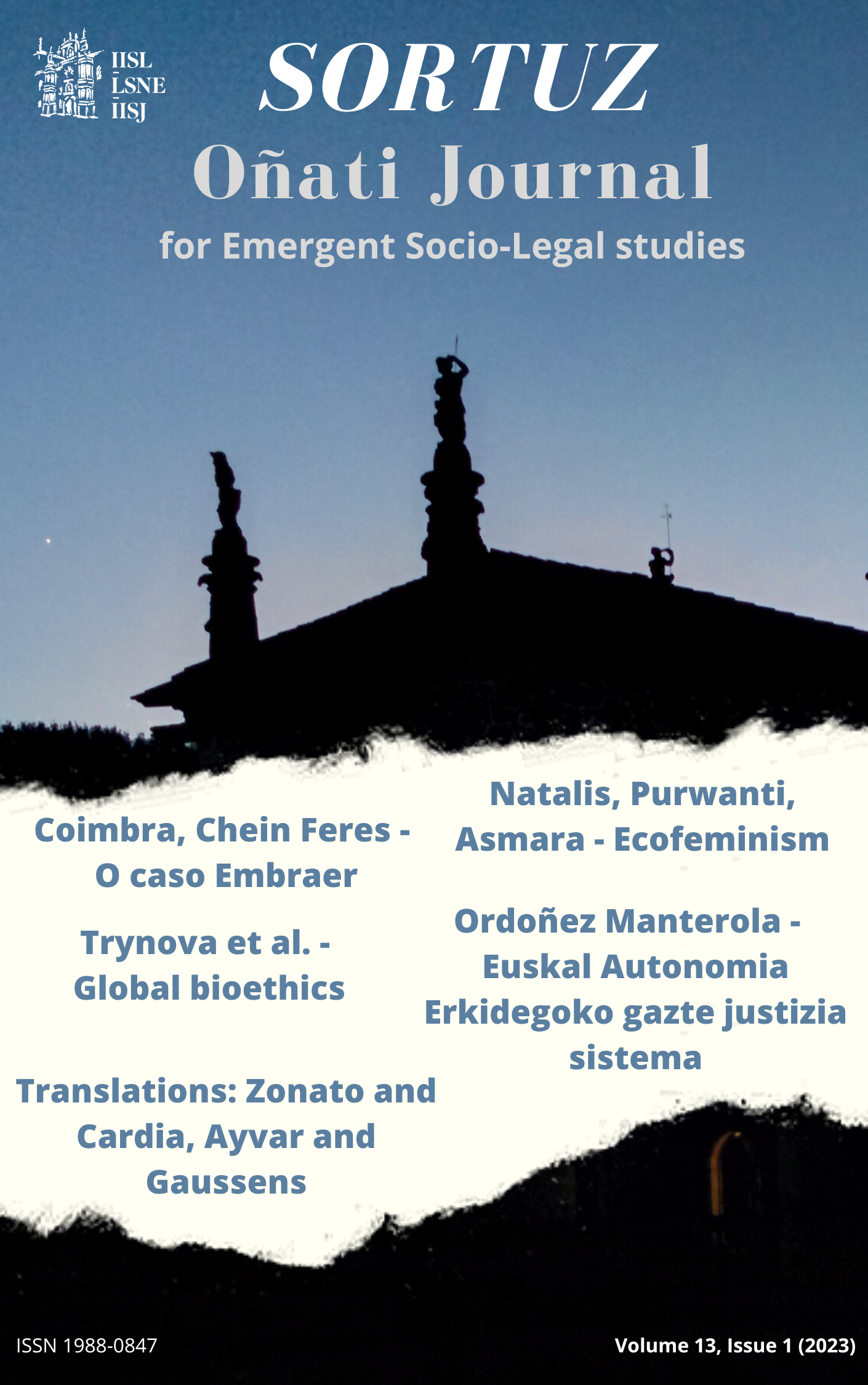
The situation of adolescent migrants who come into contact with the juvenile justice system in the Basque Autonomous Community
DOI:
https://doi.org/10.35295/sz.iisl.1487Keywords:
latino-amerikarrak, Gazte Justizia Sistema, youth, adolescence, migrants, Latin Americans, Maghrebians, juvenile justice, Basque Autonomous CommunityAbstract
In the research summarised below, we wanted to learn about the experiences of young people from Latin America and the Maghreb who have gone through the Juvenile Justice System of the Basque Autonomous Community. Young people from the Maghreb and Latin America tend to have more difficult integration processes due to their migratory processes. The research clarifies, above all, what kind of experiences they go through in their journey, as well as their needs and challenges. We also wanted to know their experiences and perceptions about the measures they have been sentenced to for crimes when they were minors. In order to find answers to these questions, a literary immersion has been made around juvenile delinquency and the legislation concerning both groups. The statistics on juvenile justice in the Basque Country show that there is a very high proportion of both groups in judicial detention measures. The empirical data are collected through fifteen semi-structured interviews with Maghrebi and Latin American youths. Women or other different groups have been excluded from the research, because women go through other oppressions and different situations. Nor have people from Sub-Saharan Africa or other European countries been taken into account due to lack of accessibility and time.
Downloads
Global Statistics ℹ️
|
678
Views
|
380
Downloads
|
|
1058
Total
|
|
Downloads
Published
How to Cite
Issue
Section
License
Copyright (c) 2023 Arantzazu Ordoñez Manterola

This work is licensed under a Creative Commons Attribution 4.0 International License.
Sortuz: Oñati Journal of Emergent Socio-Legal Studies provides immediate open access to all its content on the principle that making research freely available to the public supports a greater global exchange of knowledge.
All articles are published under a Creative Commons Attribution 4.0 International License.
Copyright and publishing rights are held by the authors of the articles. We do, however, kindly ask for later publications to indicate Sortuz as the original source.